Location Berriatua, Bizkaia.
Site chronology: Upper Palaeolithic, Magdalenian
Principal Investigator (PI): Diego Garate Maidagan
Research group: Prehistoric Graphic Activity
Atxurrako Kobie
The Atxurra Cave (Atxurrako kobie) is the perfect example of the discoveries made in the Basque Country during the second decade of the 21st century, which have filled the ‘gap’ in Palaeolithic cave art that existed in the region. Although it has been known since 1882, when the entrance to its lower level – known as Armiña – was uncovered during roadworks between Markina and Lekeitio, and has been frequently visited by cavers and tourists, its cave art was not identified until 2015.
The archaeological site at its upper entrance – the only access point open during prehistoric times – was excavated by J.M. Barandiarán between 1934 and 1935. The first remains in the lower gallery – Armiña – were discovered by A. Gálvez-Cañero in 1913. D. Garate, accompanied by J. Rios-Garaizar, began a review project in 2014. In 2015, as part of this project, D. Garate and I. Intxaurbe discovered an impressive collection of cave art in hard-to-reach areas, more than 200 metres from the entrance, which was the subject of an interdisciplinary study between 2016 and 2020 funded by the Cultural Heritage Service of the Provincial Council of Bizkaia.
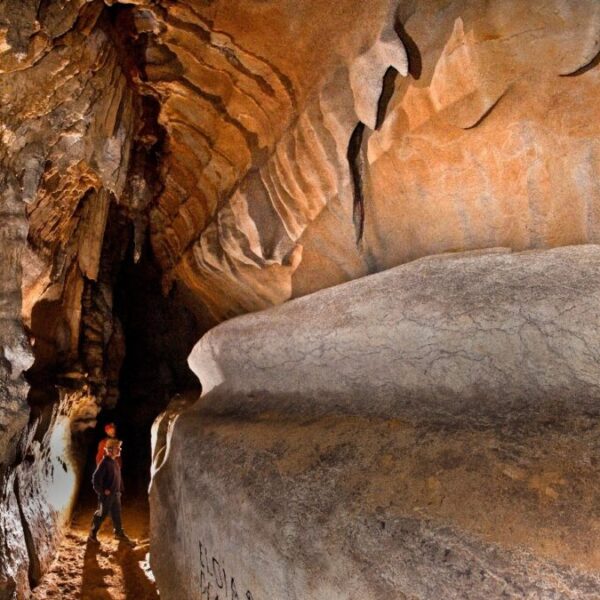
View of the cavern’s main gallery, with Sector J – known as the ‘Horses’ Ledge’ – on the left. Photograph by X. Gezuraga.
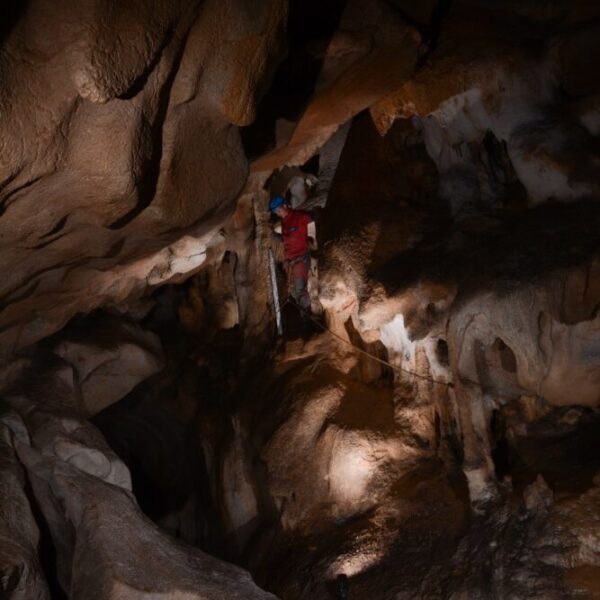
A view of the difficulties involved in accessing Sector C, known as the ‘Alcoba de los Zarpazos de oso’: it is necessary to climb up a dangerous ledge 6 metres high. Photograph by I. Intxaurbe.
Atxurra is home to the rock art site with the greatest number of animal figures in the Autonomous Community of the Basque Country. Engraving is the most commonly used technique, but the use of black charcoal and red ochre pigments has also been documented. The most common animal in the repertoire is the bison, closely followed by goats. We also see horses, does, stags, a aurochs and at least one figure with characteristics of both a bear and a reindeer. The repertoire is completed by non-figurative marks of varying complexity, though it is difficult to discern any conventional abstract symbols amongst them (perhaps a possible claviform symbol). Finally, there are some fleeting red stains in the decorated areas, which may be linked to the passage of Palaeolithic people whose bodies and clothing were dyed with ochre.
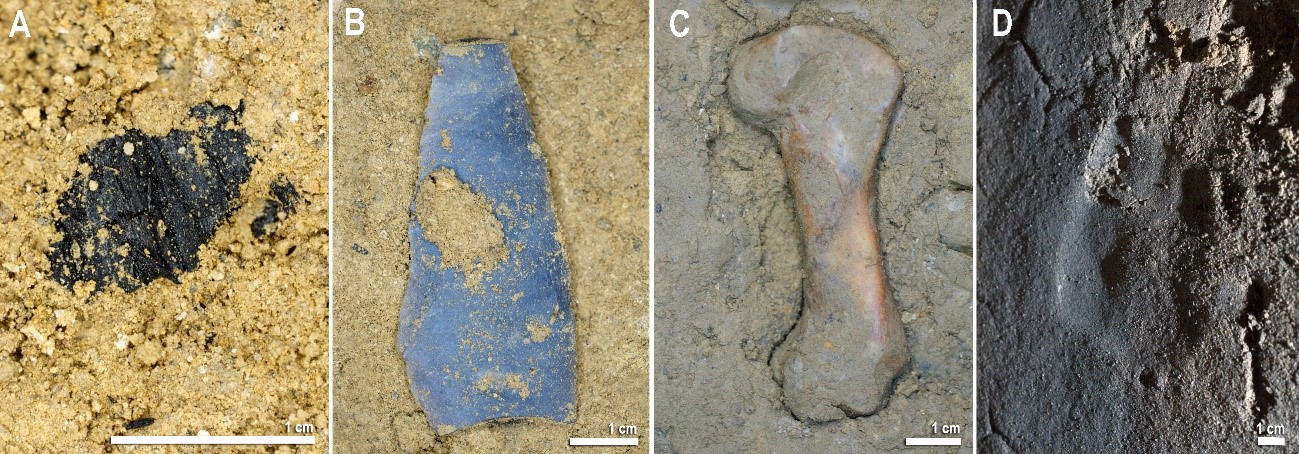
Some artefacts found in the decorated sections of the Atxurra cave. A) Fragment of charcoal; B) dihedral flint chisel; C) phalanx of Ursus sp.; D) handprint in weathered clay. Assembled by M.Á. Medina-Alcaide.
Furthermore, a significant archaeological context has been discovered at the foot of the panels, containing artefacts relating to prehistoric lighting – charcoal from torches, small hearths and a sandstone lamp – or used in the creation of the engravings – flint tools. This provides information that goes beyond the artwork itself regarding the artists, their technology and the chronology. This has been dated to the Upper Magdalenian period – between 12,300 and 11,700 years ago – based on stylistic comparisons with portable art, and confirmed by AMS C14 dating of the objects found at the foot of the panels. Similar sites to Atxurra are known on the Cantabrian coast and in France. In the Ker-de-Massat cave – on the northern slopes of the Pyrenees – there is an iconographic arrangement very similar to that of the main panel, more than 300 kilometres from Atxurra.
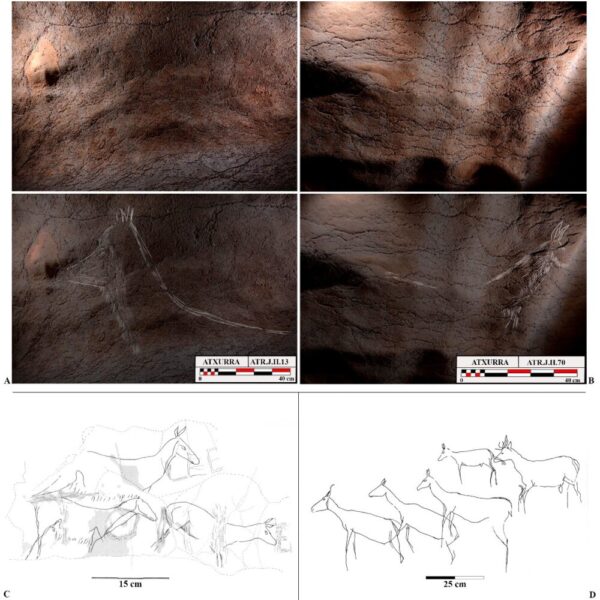
A and B) Does engraved on the ‘Repisa de los Caballos’ composition. C) Does engraved on the main panel of the Sovilla Cave (Gonzáez Sainz et al., 1993). D) Does engraved on one of the main panels of the Ker de Massat Cave (Barrière, 1990).
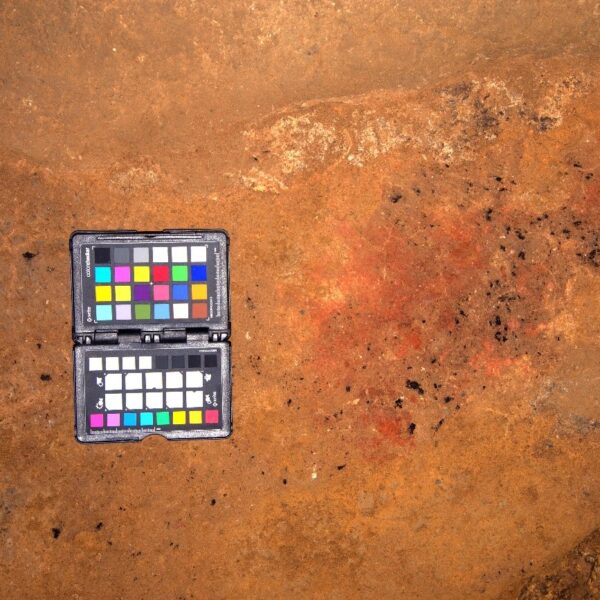
Remains of a fire dating from the Upper Magdalenian period, beneath a decorated panel: traces of charcoal, ash and fired clay can be seen. Photograph by D. Garate.